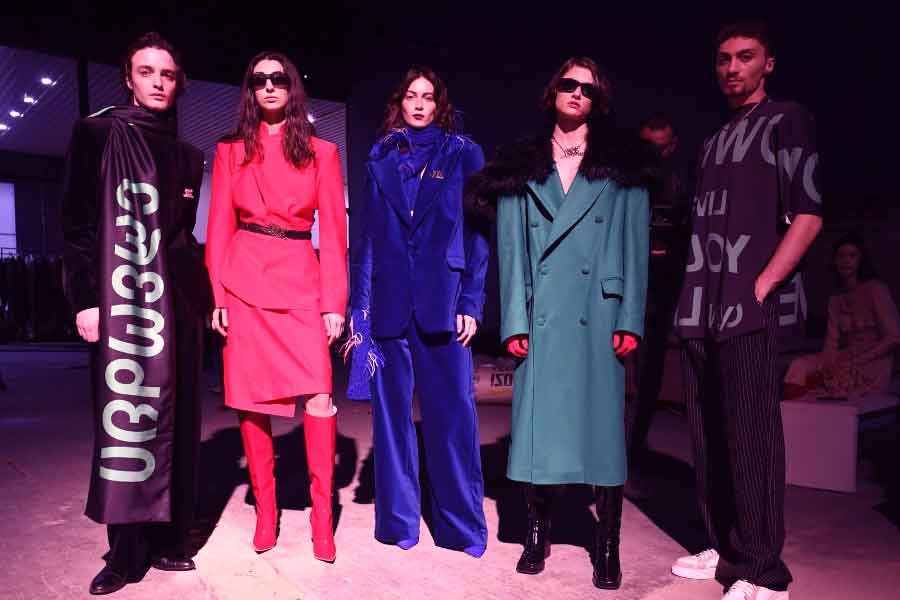
Tbilisi Fashion Week wrapped up on Monday with Georgian label SITUATIONIST presenting its Autumn/Winter collection at the historic Rustaveli Theatre, bringing a close to a noticeably restrained edition of the city’s biannual fashion calendar.
The season reflected broader pressures facing the global fashion industry, as brands continue to navigate reduced luxury spending, shifting consumer priorities, and increasingly selective international buyer attendance. In Tbilisi, these conditions were reflected in a shorter schedule and a more intimate format compared to previous editions.
Despite the quieter tone, moments of strong creative expression still emerged across the week. Several designers leaned into sculptural silhouettes, experimental tailoring, and conceptual presentation formats rather than traditional runway spectacle, signaling a shift toward more focused storytelling.
Among recurring visual themes was the return of voluminous skirt constructions inspired by 1980s proportions, reinterpreted through contemporary materials and softer architectural shaping. These silhouettes appeared in multiple collections, often combined with sharp outerwear or minimal styling to balance scale and structure.
Another notable thread was the emphasis on inclusivity and body diversity, with several Georgian designers presenting collections that intentionally avoided rigid sizing narratives. Instead, garments were styled to emphasize adaptability, wearability, and individual expression across different body types and ages.
SITUATIONIST, which closed the week’s main program, presented its latest collection at Rustaveli Theatre, a venue increasingly used for large-scale cultural presentations in the Georgian capital. The brand is known for its conceptual approach, blending streetwear influences with theatrical construction and socially aware narratives.
The Georgian fashion industry is currently undergoing its own period of adjustment, as designers balance creative ambition with market realities. While international attention toward emerging regional labels continues to grow, logistical challenges and limited infrastructure remain ongoing concerns for many independent brands.
Industry observers noted that this season’s reduced scale was also influenced by broader economic pressures and shifting event strategies, with several designers opting for private presentations or studio-based showings instead of full runway productions.
Despite these constraints, Tbilisi Fashion Week continues to serve as an important platform for independent labels and emerging designers. Its value lies in providing visibility and connection opportunities in a market that is still developing its global positioning.
Within the program, Georgian designers such as SITUATIONIST, along with a new generation of independent labels, demonstrated a strong focus on identity, material experimentation, and narrative-driven design approaches.
Local industry figures emphasized that while the scale of the event may fluctuate year to year, its role as a creative incubator remains central to the development of the region’s fashion ecosystem.
“Even in quieter seasons, the importance of having a platform where designers can present their ideas to an audience cannot be underestimated,” one industry representative noted, highlighting the ongoing need for visibility and support structures.
As the week concluded, attention turned to the broader question of sustainability for regional fashion events, and how cities like Tbilisi can maintain relevance in an increasingly centralized global fashion system dominated by Paris, Milan, New York, and London.
For now, Tbilisi Fashion Week continues to position itself as a space for experimentation and emerging voices, offering a platform where independent designers can develop their practice and engage with both local and international audiences.
While this season may have felt more restrained than previous editions, it reinforced the ongoing creative energy within Georgia’s fashion community — and its determination to remain part of the global conversation despite structural limitations.